

A research team from the Department of Physics at the University of Jaén (UJA), in collaboration with the Department of Computer Science at the Carlos III University of Madrid (UC3M), has designed a freely available database that estimates the production of photovoltaic solar energy that could be generated in Spain. Named SHIRENDA_PV, it has been developed based on meteorological data and artificial intelligence techniques, and in combination with other tools, it allows estimating the number of solar plants that would need to be installed throughout the country and the ideal location to create a national electrical system based on renewable energies.
The study, carried out within the framework of the MET4LOWCAR research project of the Ministry of Science, Innovation and Universities, also funded by the Ministry of University, Research and Innovation, addresses a critical point in the transition to such a system, such as the need for reliable databases of resources (solar, wind, and hydraulic), with high spatial and temporal resolution, covering long periods of time. «Only with this type of databases can significant results be obtained in studies of planning systems based on renewables, essential for the energy transition,» points out UJA professor David Pozo, co-author of the work and project leader in which the study is framed.
Until now, physical models were used to generate this type of databases, simulating the behavior of real solar plants based on meteorological data. «The problem is that, to simulate solar generation throughout Spain, parameters such as orientation or panel technology are needed, which are unknown. This leads to very significant errors, which is why the existing databases were not reliable enough,» explains Pozo.
The experts have applied a different methodology, combining meteorological data and real solar energy generation data from the period 2015-2020, provided by the Spanish Electricity Network (REE), to train machine learning models. They used three years for training and two for validation, and with the algorithms obtained, they estimated photovoltaic solar production backwards, from 1990 to 2020 for the entire Spain.
As a result, they have created SHIRENDA_PV, a database of photovoltaic solar generation spanning three decades and with hourly resolution. The tool is presented in the article titled ‘A novel method for modeling renewable power production using ERA5: Spanish solar PV energy’, published in the journal Renewable Energy.
Where and when is more energy produced?
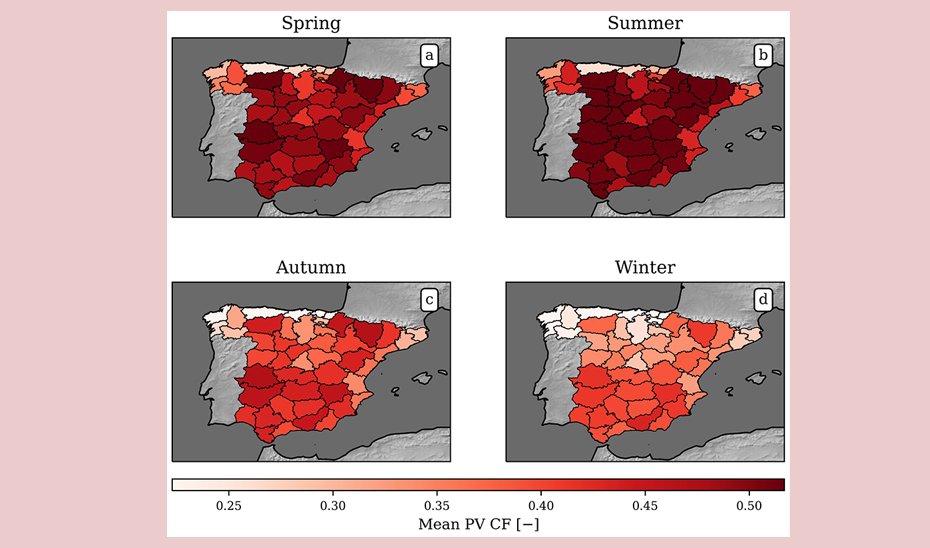
This database allows analyzing changes in solar generation from year to year, the most stable regions, and those with the highest production. «There are areas in Spain that have very stable solar generation over 30 years, and others where it is particularly synchronized with demand, even though their production on average is lower. These types of areas can be of great interest for an electrical system based on renewables, as they help reduce generation variability,» details the UJA expert.
The study identifies the southern and southwestern regions, especially Extremadura, as having the highest solar production. It also reveals that winter is the most challenging season in Spain, with a very pronounced fluctuation. This is due to the effect of the North Atlantic Oscillation (NAO) – the most important climate variability phenomenon in Europe – which can vary by up to 20% from one winter to another. Specifically, during negative phases, generation can drop by up to 16%, especially in the southwest of the country, while in positive phases, it increases by up to 10%.
Solar, wind, and hydraulic energy
SHIRENDA_PV not only allows optimizing the location of solar plants but also forecasting climate variability and its impact on energy production. Moreover, it is open access, facilitating its use by the research community, companies, and administrations responsible for the energy transition in the country.
The researchers have also developed similar databases for wind and hydraulic energy generation, all freely available, to complete the record of renewable potential in Spain. In the next project, already underway, they are using all three to analyze what would be an optimal electrical system for the country based on these energies and to study their behavior and reliability in the face of climate change, among other objectives.