

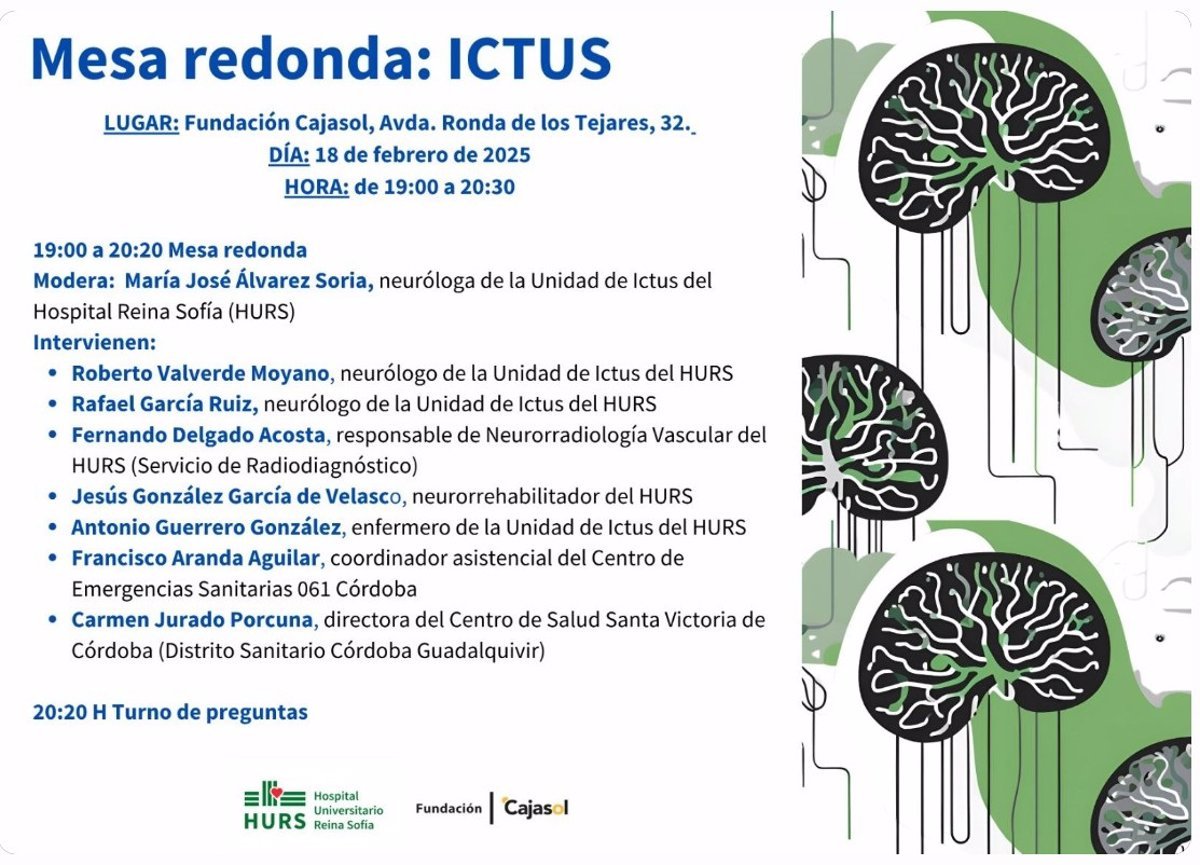
The headquarters of the Cajasol Foundation in Córdoba, on Tuesday, hosts a round table dedicated, organized by the Hospital of the University Reina Sofía in Córdoba and is registered in the cycle of informative days, which takes place every four months in the Foundation Foundation and that focus on approaching high impact and incidence pathologies in the population.
Tuesday, as reported by the Junta de Andalucía in a note, is the first meeting of the year, which will be followed by two more, scheduled for spring and fall of 2025. The Reina Sofía hospital is structured in three blocks, in order to explain the different links in the ICTU care chain.
«The objective is for professionals from different levels of care involved in the comprehensive care of this pathology to share their knowledge and experiences,» said Dr. Álvarez.
The incidence of stroke has increased significantly in recent decades, largely due to the rise in hypertension, diabetes, dyslipidemia, obesity, and sedentary lifestyle, as well as increased life expectancy. Currently, stroke is the second leading cause of mortality in Spain and the first among women, affecting between 120,000 and 130,000 people each year. At the Reina Sofía Hospital, over 1,200 stroke patients are treated annually.
Dr. Álvarez emphasized the importance of recognizing symptoms and acting quickly: «Severe headaches, speech difficulties, sudden loss of vision, deviation of the oral corner, and loss of strength or sensitivity in a part of the body. Before these warning signs, it is essential to call 061 to activate the ICTU code as soon as possible.
Round table
The meeting is divided into three thematic blocks: acute phase, care and procedures, and rehabilitation and secondary prevention. Firstly, the definition and types of stroke, the main modifiable and non-modifiable risk factors, the detection of warning signs, the importance of treatment, and the transfer process to the hospital are addressed.
In this first section, neurologists Ittus Roberto Valverde and Rafael Ruiz, along with Francisco Arada, Health Coordinator of the Emergency Center 061 Córdoba, participate.
In the second part of the round table, the role of medical care and the neuroradiology team in stroke treatment, including care, diagnosis, interventional procedures, and long-term prognosis are discussed. Antonio Guerrero, nurse from the Ittus unit, and Fernando Delgado, head of vascular neuroradiology at the hospital, take part.
The final block analyzes the importance of recovery, rehabilitation resources (speech therapy, physiotherapy, and occupational therapy), referral from primary care, and monitoring of risk factors. In this section, Jesús González, neurorehabilitation specialist at the Hospital, and Carmen Poruna, director of the Santa Victoria Health Center in the Córdoba Guadalquivir Health District, are involved.
Prevention
Prevention of stroke involves controlling cardiovascular risk factors such as high blood pressure, diabetes, and cholesterol, as well as avoiding harmful habits like smoking, alcohol, and other drugs. It is also essential to follow a balanced diet, reduce fat and salt intake, engage in regular physical activity, and avoid a sedentary lifestyle. In patients with cardiac pathologies, strict control is crucial, as more than a third of strokes originate from heart disease.
The Stroke Unit at the Reina Sofía Hospital, established in 2018 and already serving over 5,300 patients, has six specialized care beds for stroke patients. It also features a neurosonology laboratory (for performing supra-aortic and transcranial ultrasounds for cerebral hemodynamic studies), specialized medical care in the management and monitoring of cerebrovascular diseases, and ambulatory telemetry (aimed at detecting arrhythmias at risk of embolism).
Among other available resources at the Reina Sofía Hospital, a vascular neurology consultation for patient monitoring and secondary prevention is highlighted. Additionally, the Center has a multidisciplinary commission to address dysphagia in stroke patients, composed of nutrition, rehabilitation, medical care, neurology, and speech therapy.
The most complex health services participate in the diagnosis and treatment of cerebrovascular diseases, as a multidisciplinary approach is key to providing opportunities for patients.
ICTU Code
The ICTU Code is an organizational system in which extrahospital emergency services and hospitals collaborate with the Stroke Unit, as well as the Andalusian Health Service (SAS), so that a patient with acute stroke reaches the hospital as soon as possible, where everything is ready to act immediately, ensuring that the time from detecting a person with a stroke to the start of treatment is as short as possible.
There are two main treatments in the acute phase of ICTU, to achieve the impact shown in reducing the patient’s risk of disability: intravenous fibrinolysis (can be performed at any hospital) and mechanical thrombectomy (requires specialized interventional neuroradiology).