

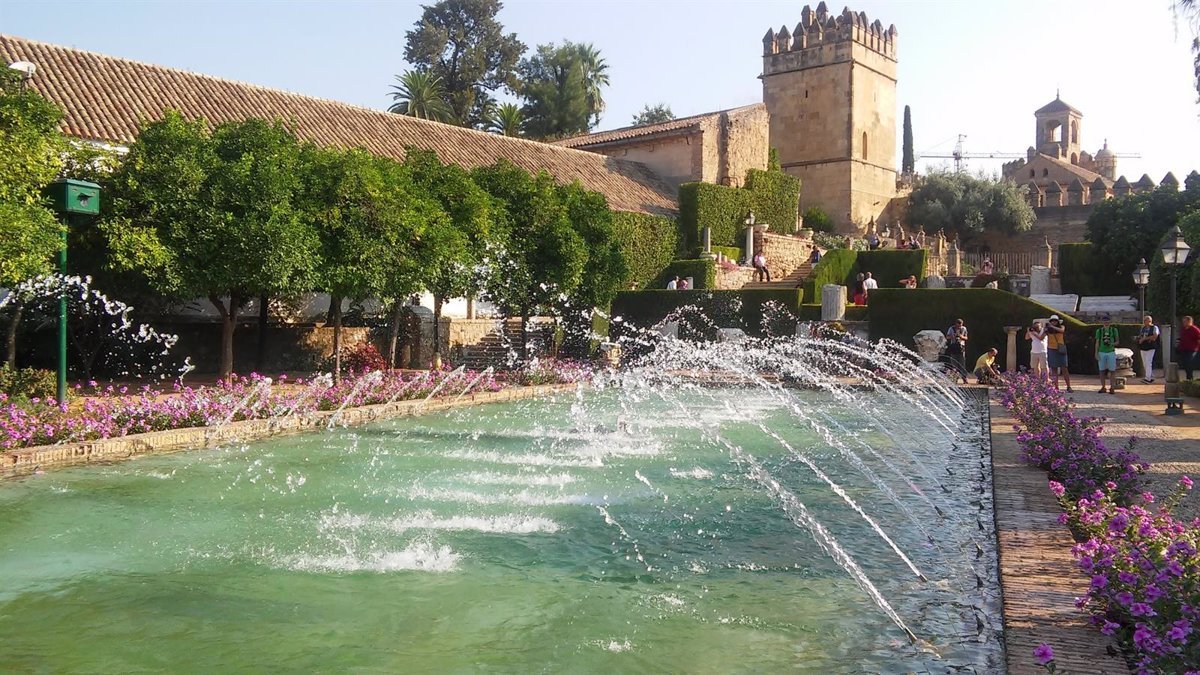
The Provincial Heritage Commission of the delegation of culture and sports in Córdoba, chaired by territorial delegate Eduardo Lucena, has given a favorable report on the project presented for the adaptation of the fountains and pond (GMU).
As detailed by the Andalusian Council in a note, the planned intervention focuses on these elements of the new gardens, which were designed in the 1970s in the Alcázar country. These are the three large ponds located in the north and the two fountains of Paseo de los Reyes Católicos, where leaks that could affect the environment have been detected.
The project considers the most notable actions to be the structural repair of the five elements to ensure durability, with the opening and sealing of cracks, as well as the waterproofing of the brick floors and vertical walls of the three ponds, the prior cleaning of the pressure, to maintain the current appearance.
The waterproofing of the fountains in Paseo de los Reyes Católicos is also included with chlorocaucho paint, after the support and new water supply, Valvery, and submersible pumps.
In its report, the Heritage Commission warns that the works «must be carried out under optional direction,» as well as this, «if the renovation of the facilities has assumed a condition in the basement, an archaeological control of the earth movements must be processed by a responsible declaration or to integrate the action into the recent authorized control.»
El Alcazar de los reyes cristianos
The new Alcázar or the Christian kings were declared a monument by decree on June 3, 1931. It is a cultural interest property (BIC), based on the Spanish historical heritage law and is registered in the general catalog of historical heritage (CGPHA) by the historical law of Andalusia’s heritage. It is also part of Córdoba’s historical group, protected by the Royal Order of July 26, 1929, and by Decree 63/2003, of March 11, which extends the delimitation of Córdoba’s historical complex. It is listed in the special plan as a village monument.
The scope of the Christian kings constitutes a part of a much broader ensemble that housed the center of political power in Córdoba, integrating the residence of the governors of Visigothy, Alcázar Omayya, Almohade Alcazaba and, after the Christian conquest of 1236, Casas del Rey.
As such, the Palaciega fortification acquires the dimensions with which it is known today after Alfonso XI’s 1328 project, which completes an earlier one by Alfonso X. in the mid-12th century, in the context of adapting the building to new military techniques derived from the incorporation of the Inaina military tower.
In 1482, after the transfer of the Alcázar to the Sacred Office by the Catholic monarchs, the Inquisition Tribunal was installed, causing its adaptation for residential use and the Ecclesiastical Tribunal. With this use, it was maintained until 1810, when it was adapted when the Napoleonic troops’ headquarters were established in the city, until 1821 it certainly went to the local council and with it was remodeled as a public prison, maintaining as such until 1931 when it was declared a historical-artistic monument.
According to studies, the high gardens and the terrible basins and bases that invent them are from the last third of the 19th century. The lower gardens were designed and built by architect Víctor Esibano in the 1950s of the last century.
It is configured as a tight quadrilateral by four towers: the Tower of the Lions of Northern Vestibles, the Tribute Tower of the North, the Paloma Tower in the southeast angle, and the Inquisition Tower South-West. Inside, the built shelves are organized on the north and south sides, along with another central one to define a factory that houses two courtyards, Mucujar or Maură to the west and the weapons courtyard or the women’s terrace to the east.