

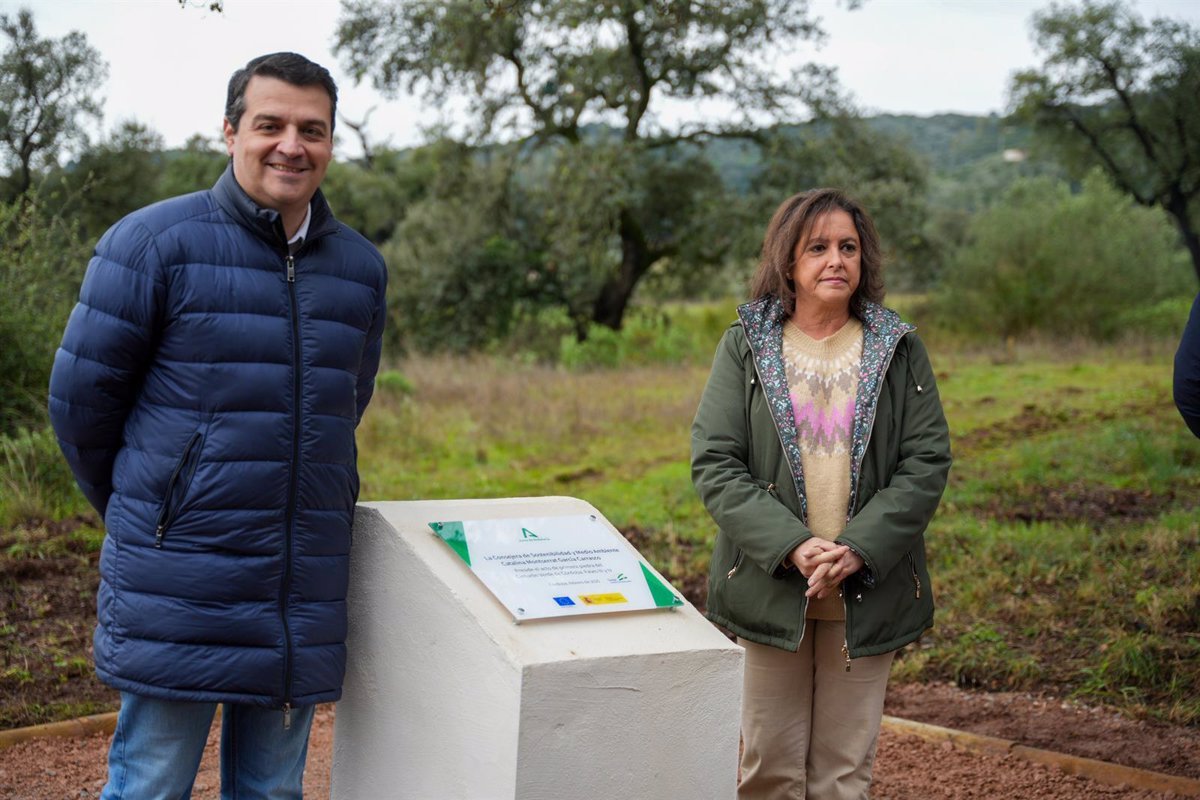
The Minister of Durability and Environment in the Andalusian Board, Catalina García, laid the foundation stone for phases III and IV of the green belt of animal paths on Monday, a strategic project for the city aimed at promoting ecological connectivity, sustainable land use, and space recovery.
The initiative, classified in the territorial planning of the Board, had a total investment of 4.1 million euros, co-financed with federal funds and European backers, of which 3.7 million correspond to the new phases of the works.
This green belt, with a length of 20 kilometers, was designed to strengthen the city’s green infrastructure, allowing the connection between different natural areas and promoting the public use of animal paths. The program, started in November last year with previous work, is planned to be completed by June 2025.
During the speech, the minister emphasized that this initiative «marked a stage in environmental planning in Córdoba, offering the city an ecological belt that improves territorial connectivity, while enhancing biodiversity and leisure opportunities in contact with nature.»
Additionally, she pointed out that the green belt will allow the interconnection of green gates in Trassierra and Córdoba, connecting with the university campus in Ranales and facilitating the connection between the city and its natural surroundings.
Phases III and IV cover large-scale works that include adapting and restoring historical paths, installing walkways and crossing structures to improve accessibility, as well as environmental restoration by planting local species. These interventions were awarded to companies Sepisur XXI, Ute Mantinsa SA, and Adoquines Morales, while the work management was entrusted to consultants TG4 AEC.
The Córdoba Green Belt project originated from the revision of the General Urban Planning Plan (PGO) in 2001, when the need to establish a new look for animal routes affected by urban development was raised. For this, in 2007, an agreement was formalized between the municipal management of urban planning, the Directorate General of Heritage of the Ministry of Economy and Finance, and the Ministry of Environment, to manage and develop this infrastructure. After a expropriation process started in 2009, the final appearance of the green belt was defined in 2014.
Connectivity and Security
Three key interventions were planned in phase III. Firstly, the construction of two hanging bird platforms 65 meters long with high-level wooden platforms, connecting road CO3405 with the Cost of Betrayal, improving accessibility in a one-kilometer stretch.
Secondly, the adaptation of a 5.5-kilometer route that will connect the Cost of Betrayal with the future green road between Córdoba and Cerro Muriano, with infrastructure such as flooded and rest areas. Finally, two crossings will be executed on roads CO3405 and CO3408 to ensure appearance safety, installing concrete frames to facilitate traffic without interfering with wildlife.
On the other hand, Phase IV will strengthen the connection of the Córdoba-Cerro Muriano Green Way with the green gate of Córdoba, along a 5.5-kilometer route. This action will include the adaptation of roads, the installation of a metal bird on the Guadalmellato canal, creating rest areas and restoring the environment with native vegetation.
Regarding phases I and II, already completed, the first phase consisted of connecting the Trassierra green gate with the Calea ravine connection with the Hermitages, continuing until reaching the customs university area, at the intersection with CO3405 Road (2.3 kilometers). In the four phases, Catalina García detailed that the number of working days will be 9,713.
Recovering the Animal Path
The Minister of Sustainability and Environment emphasized the importance of this animal network in Andalusia, which is «a natural heritage of enormous value due to its initial function related to transhumance and its potential as backbone axes, generating biodiversity and recreational spaces for the public.»
Since 2019, the Andalusian Board has allocated 67.7 million euros to improve and conserve these infrastructures throughout the autonomous community, of which 12.3 have been invested in the province of Córdoba.
Specifically, in this province, an intervention plan is currently being carried out with a total investment of 4.5 million euros, allowing action on over 40 animals distributed in 25 municipal terms. Beneficiary areas include Campiña, Sierra de Cardeña-Montoro, the special conservation area of Guadato-Bembézar, the sub-Betic mountains, and the north of the province, with an investment of 5.8 million euros in animals in Córdoba in 2025.
Catalina García emphasized that animal routes are a highly important territorial network that promotes landscape integration and ecological connectivity. «Beyond their traditional use by animals, these natural corridors play a key role in land management, facilitating rural mobility, promoting sustainable tourism, and offering leisure alternatives in well-preserved natural environments,» she added.
In this sense, the head of sustainability and the environment reiterated that the Andalusian Board «is committed to recovering and valuing these paths, ensuring them and promoting a development model compatible with environmental protection.»
In this context, she mentioned that the works of the Córdoba green belt «were designed with a strong sustainability component, minimizing the impact on the environment and incorporating construction solutions adapted to the natural conditions of the environment.»
The First Stone
The laying of the foundation stone for phases I and IV of the green belt was attended by the Deputy Prime Minister of Sustainability and Environment, Sergio Arjona; the Director General of Forestry Policy and Biodiversity, Juan Ramón Pérez Valenzuela; the Mayor of Córdoba, José María Bellido, and the territorial delegate of the Ministry in Córdoba, Rafael Martínez.
Also present were officials from the Andalusian Environmental and Water Agency (Amaya), such as its director general, Javier de Torre, and the Provincial Coordinator of Córdoba, Marial Sacerdote. Along with them, the head of the Protected Natural Space Service in Córdoba, Carmen Torres, was also present;