

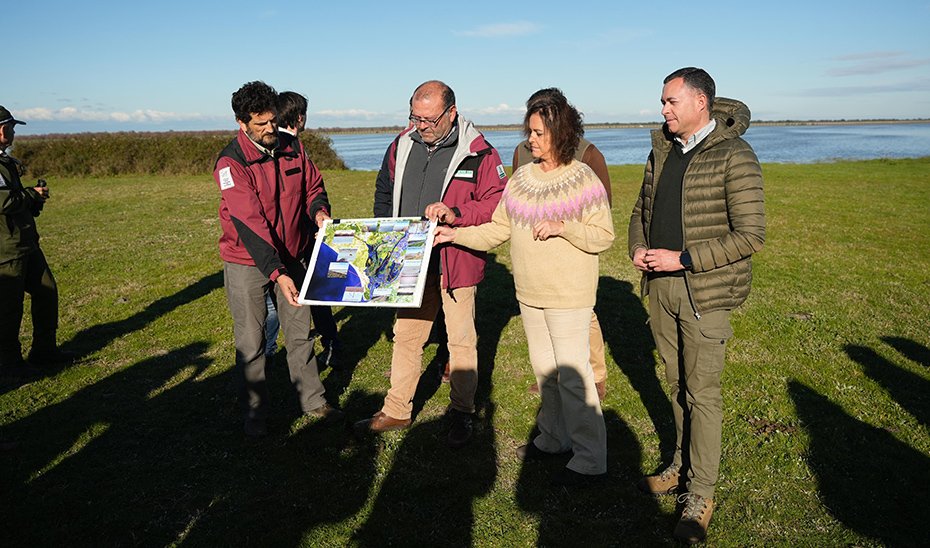
The Sustainability and Environment Councilor of the Andalusian Government, Catalina García, has visited the Doñana marshes, touring the sites of La Rocina, El Rocío, and El Puntal, as part of the World Wetlands Day, celebrated every 2nd of February to commemorate the signing of the Ramsar Convention on the conservation of these ecosystems, from 1971. This commemoration aims to raise awareness about the importance of wetlands for biodiversity and the fight against climate change, as well as their key role in water regulation and the conservation of numerous species.
Catalina García has emphasized that the Andalusian Government is promoting active environmental management in wetlands, based on planning, restoration, and continuous monitoring of these ecosystems. This approach aims, on the one hand, at conserving protected areas and also incorporates adaptive measures to improve their resilience to climate change and ensure their long-term ecological functionality. «It’s not just about protection, but about constantly acting to optimize the wetlands’ ability to regulate water, absorb carbon, and serve as a refuge for biodiversity,» she pointed out.
During the visit, the councilor was accompanied by the Director General of Protected Natural Spaces, José Enrique Borrallo; the Director of Doñana National and Natural Park, Juan Pedro Castellano; the President of the Participation Council of the Doñana Natural Space, Enrique Mateos; the Government Delegate of the Junta in Huelva, José Manuel Correa, and the Territorial Delegate of Sustainability and Environment, Pedro Yórquez, among other authorities.
Catalina García highlighted the work carried out by the Andalusian Government in the protection and restoration of Andalusian wetlands, emphasizing that «Andalusia is the autonomous community with the highest number of protected wetlands within the Ramsar List and has the Wetlands Inventory of Andalusia, which includes 228 sites of high ecological value.» In this regard, she recalled that the Andalusian Government has been protecting these ecosystems since the 1980s and that new restoration and management plans are currently being developed.
One of the most significant announcements during the visit was the launch of the new environmental management model for the Veta la Palma estate, whose acquisition by the Andalusian Government, with an investment of 73 million euros, marked a milestone in wetlands conservation. The councilor explained that since January 2024, intense work has been done with the estate’s technical team to adapt the hydraulic management model to the new conservation and biodiversity purpose.
«This first year of transition has allowed us to make key adjustments in water management and carry out interventions to improve the ecosystem,» García stated, pointing out that in December, the process for hiring the hydraulic management support service was completed, with an annual investment of 792,000 euros, which started on February 1st.
The councilor emphasized that the acquisition of Veta la Palma ensures the direct management of one of the areas of greatest environmental value within the Doñana Natural Space, allowing for an increase in biodiversity and optimization of water management. «We are ensuring that Doñana regains its ecological functionality, adapting the management of this key enclave to respond to the challenges of climate change,» she added.
Investments in Wetlands
The Andalusian Government is carrying out investments worth 15.4 million euros in wetlands restoration through European funds from the Recovery, Transformation, and Resilience Plan (PRTR). Catalina García explained that «these actions include the environmental restoration of key areas, habitat improvement, and the acquisition of strategic wetlands for their conservation.»
She also mentioned that the Wetlands Inventory of Andalusia is continuously expanding, with the inclusion of new sites, such as Laguna del Conde or El Salobral in Córdoba, which will improve their protection and planning. Among the highlighted investments in Doñana, the councilor mentioned projects of environmental restoration, improvement of hydraulic management infrastructures, and the recovery of temporary lagoons, many of which had seen a reduction in functionality due to drought.
The Impact of Rains on Doñana
During her visit, the councilor highlighted the positive effects of the rains in recent weeks on the Doñana marshes. «Since January 2015, there hasn’t been such a positive volume of precipitation at this time of year,» she explained.
According to data collected from various meteorological stations in the park, in some areas, more than 370 millimeters of accumulated precipitation have been recorded, allowing for a significant flooding of the marsh and the reactivation of key lagoons for the surrounding fauna. «This situation has favored the arrival of numerous wintering birds that use Doñana as a resting and feeding area in their migration from Northern Europe,» she indicated.
Among the areas most benefited by the rains are the lucios of Vetalengua, El Membrillo, and Lucio de los Ánsares, as well as the Caño Guadiamar and the canals of the small Entremuros basin. There has also been an increase in the flooding of the Veta la Palma estate, consolidating it as a key area for the ecological recovery of the park.
Actions in Doñana
In the specific case of Doñana, investments in the framework of the PRTR exceed 6 million euros and include projects of environmental restoration, habitat improvement, and reinforcement of hydraulic management infrastructures. «We are making progress in the recovery of temporary lagoons, the eradication of invasive exotic species, and the adaptation of ecosystems to the effects of climate change, as well as improving the functionality of the canals and the park’s micro-drainage network,» detailed García.
In addition to these interventions, the Andalusian Government has promoted the improvement of public use infrastructures in Doñana National Park, with actions in the Visitor Centers of La Rocina, El Acebrón, José Antonio Valverde, and the Ice Factory. «These spaces are essential for both environmental education of students and visitors and for the development of ecotourism, an activity that contributes to the sustainability of the environment,» the councilor pointed out. Likewise, an adaptation of the gates system of Doñana National Park has been carried out, aiming to optimize the connection of the park’s canals with the Tower Arm and the Guadalquivir River, improving the water management of the area.
Similarly, restoration work is being carried out in the area affected by the Las Peñuelas fire in 2017, which resulted in the loss of more than 10,000 hectares. «This restoration plan has been recognized as a reference model in the recovery of burned areas and is allowing us to strengthen Doñana’s resilience to future climate challenges,» the councilor explained.
Catalina García reaffirmed the commitment of the Andalusian Government to the protection and sustainable management of the wetlands in the community. «Wetlands are essential for ecological balance, water regulation, and biodiversity conservation. From the Junta, we will continue working to ensure their conservation and to make Doñana a model of sustainable environmental management,» she concluded.